Distance and line of sight on the systemic board
On a systemic board, two things speak above all: how far apart the figures stand and where they are looking. The family board, from which the systemic board developed, already made relationships visible in this way. This page shows how to read both – and how the Parafeld™ System Board makes distance and gaze visible in centimetres and fields of view.

What distance shows
The distance between two figures stands for closeness or distance – as the person setting up experiences the relationship. It is not only the individual pair that counts, but the whole picture:
- Who stands close together? Figures that stand close together often form a group.
- Who stands alone? A figure at a great distance from all the others is noticed immediately.
- Who stands at the edge? The edge of the board or of an area shows who hardly belongs any more.
- How far away is the goal? The distance to a goal or a resource is also part of the picture.
The board is a square one metre on each side, on the scale of the figures. The “Distances” switch in the “Camera” widget shows the distance in centimetres from the selected figure to all other figures. How much distance counts as “close” is decided not by the number but by the person who did the placing: for one person 30 centimetres feels familiar, for another it is already too close.
What line of sight shows
Each figure shows with its nose and notch where it is looking. A few basic patterns emerge from the line of sight:
- Mutual gaze: two figures look at each other.
- One-sided gaze: one figure looks at another that is looking elsewhere.
- Looking past: one figure looks just past another.
- Turning away: a figure looks out of the picture or towards the edge.
- Behind someone: a figure stands behind another that cannot see it.
- Unseen: nobody is looking at a figure.
A figure is turned with the blue ring – it follows the pointer with its line of sight – or with the Q and E keys in steps of 15 degrees.
How the board makes the gaze visible
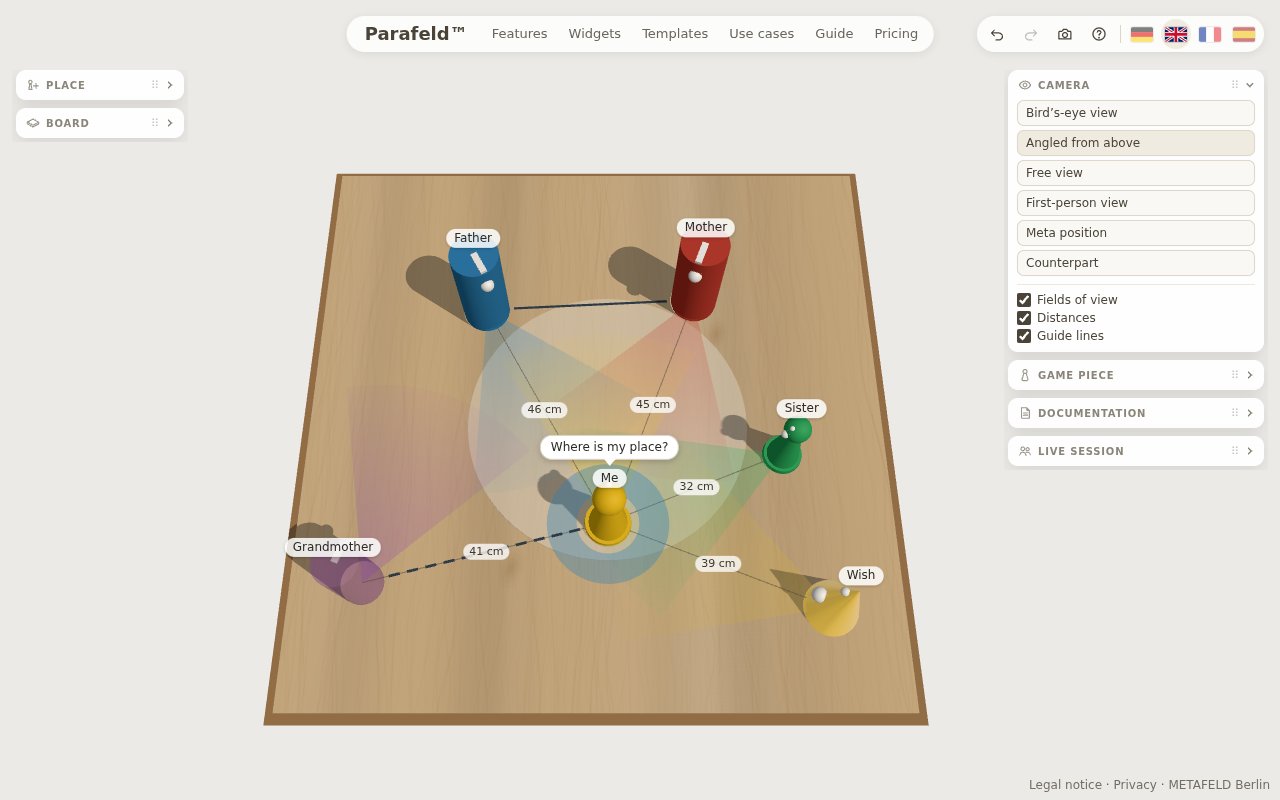
- Fields of view draw a wedge on the board in front of each figure, showing where it is looking. This makes it possible to see at a glance who has whom in view and whom nobody is looking at.
- Lines of sight in the report: for the last picture, the report lists who is looking at whom – “A looks at B” or “A and B look at each other”. A figure counts as being looked at if it stands within 30 degrees on either side of the line of sight.
- First-person view: what it is like to stand in a place is shown most clearly by the view through the eyes of the figure. What it does not see is then really not in the picture.
- Counterpart: switches to the figure being looked at. This way a relationship can be viewed from both sides.
More about the views under First-person view.
Reading distance and gaze together
Only together do the two features form a picture. Two figures can stand close together and still turn away from each other, or be far apart and still look at each other. A figure can stand at the centre without anyone looking at it. Such descriptions are observations, not findings. What an arrangement means is said by the person who set it up; the facilitator asks. The role that shape, size and colour play is described on the page The meaning of the figures.
Trying out and comparing changes
At the systemic board you do not only read, you also change things: bring a figure one step closer, turn another round. In the first-person view, the arrow keys ↑ and ↓ move the figure two centimetres forward or back, ← and → turn it by five degrees. If you have captured the starting picture as a snapshot beforehand, the comparison shows which figure has moved by how many centimetres or turned by how many degrees.
Questions about distance and gaze
- Who is looking at whom – and who is looking past whom?
- How is this distance for you: too close, too far or just right?
- Who is standing behind this figure?
- What would change between these two figures if they looked at each other?
- What would be different if this figure came one step closer?
More questions are listed under Prompting questions.
Frequently asked questions
What does it mean when two figures look at each other?
At first only that they are facing each other. Whether this stands for connection, control or something else is said by the person who set it up. A good question is: “What is it like for this figure to be looked at like this?”
How do I measure the distance between two figures?
Select a figure and turn on the “Distances” switch in the “Camera” widget. The board then shows the distance to all other figures in centimetres, measured from centre to centre.
Do areas and objects have a line of sight?
No. Only figures look. Areas mark places that a figure can step onto; objects such as a wall or stone stand for things. More under Floor anchors.